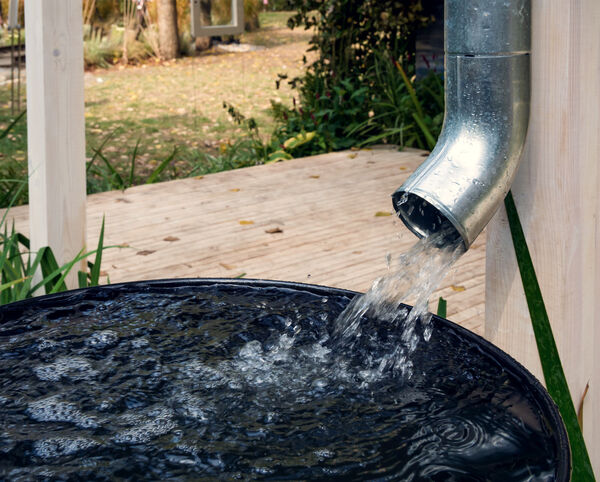
With the right plan, the rainwater from your roofs covers a good share of your water demand, and sometimes even all of it.
From drainage problem to water source
On many business sites, rainwater is mainly a problem: paved surfaces, full buffers and, during heavy downpours, overflows or emergency discharges. At Aluminium Duffel, the rainwater from more than 20 hectares of roof flowed together with process water into a single basin. By disconnecting ± 18,000 m² of paved surface, the number of overflows falls by 23%. And 79,000 m³ of rainwater can be collected each year for drainage, infiltration and reuse.
How much can it deliver?
That depends on your roof area, the rainfall pattern, the buffer volume and above all the daily profile of your demand. That is why we simulate use over several years of real rainfall data. Some examples from our studies:
- PepsiCo Veurne can collect 47,889 m³ of rainwater a year from roofs and paved areas.
- In the offices of AG Real Estate, average consumption can fall from 384 to 216 litres per m², and to 139 litres per m² with rainwater.
- For Montea Lummen, a fully self-sufficient logistics site proved feasible, with drinking water from rainwater.
To be fair: for large process users, rainwater is usually a supplement. At Agristo it covers about 6% of the demand for clean water. Useful, but there the real gains lie in reusing wastewater.
Quality determines the application
Rainwater is soft and often of good quality, but leaves, dust and organic material easily end up in the buffer. Pre-filters, leaf traps and a good tank set-up prevent many problems. For toilet flushing, simple treatment is enough. For cooling towers, steam boilers or process water, more treatment is needed, up to drinking water quality.
Three questions for your site
- How many m² of roof and paved surface do you have, and where does that water go now?
- Which applications can use lower-quality water?
- Is a renovation, extension or new permit planned? Then this is the moment to include rainwater.

More insights
When does industrial water reuse pay off?
Treated wastewater and alternative sources can replace a surprising share of fresh-water intake, often with a payback that makes the CFO smile.
Getting ahead of BBT+ and stricter discharge limits
Discharge limits only move in one direction. Companies that treat compliance as an early design problem avoid the scramble later.
More water insights?
Follow the projects we work on, or ask us your water question.